FloodIt
recursive flood-fill puzzle game
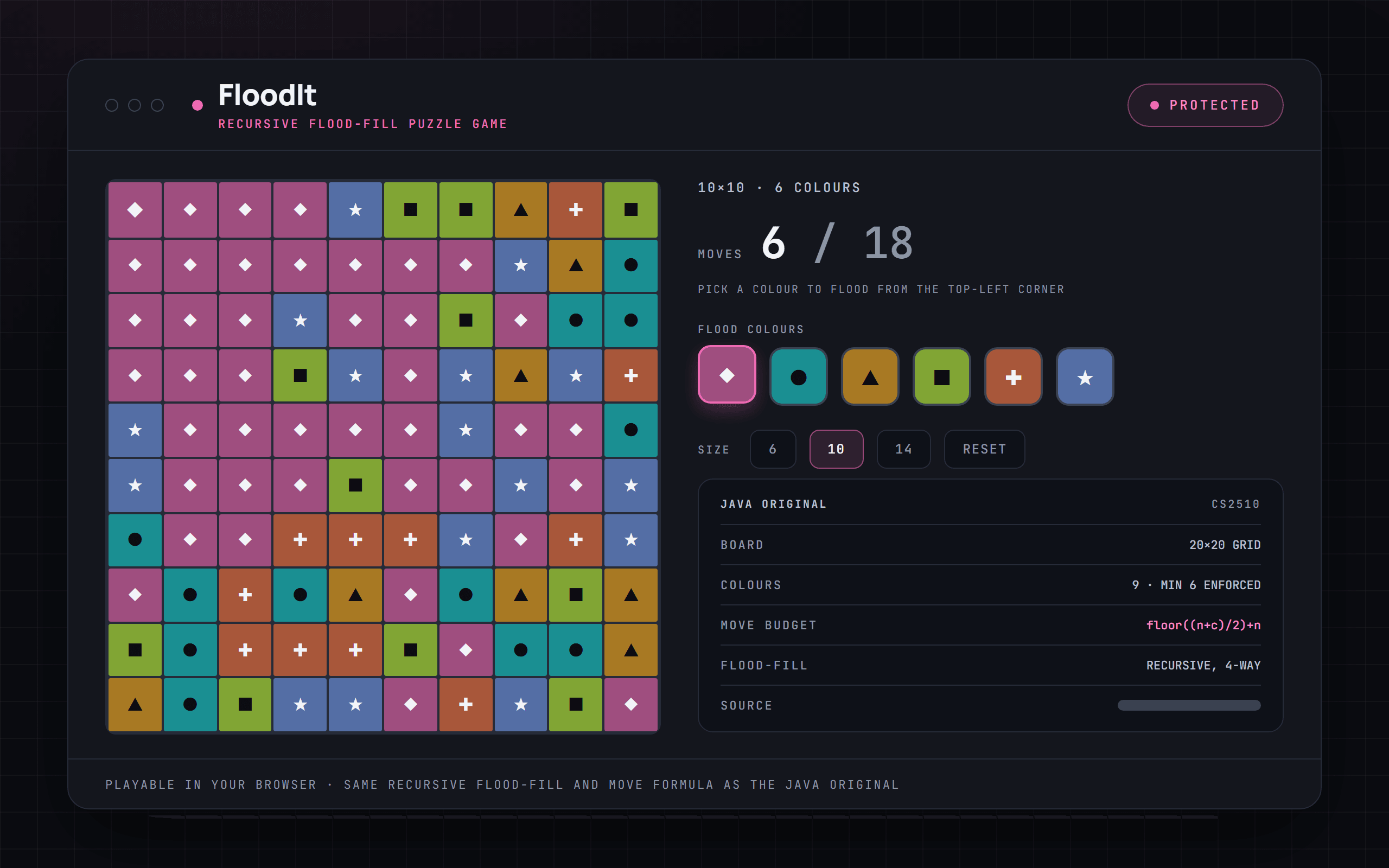
A complete, test-covered FloodIt: a mutable cell graph, recursive four-way flood-fill, and win, lose and reset states governed by a fixed move budget.
Pick a colour to flood from the top-left corner. Match the whole board to one colour within the move budget. Click a swatch, or focus the board and press 1 to 6 (arrow keys move the cursor, Enter commits).
Move 0 of 18. 18 moves left.
Playable in your browser: flood the grid to one colour within the move budget. Same recursive flood-fill and move formula as the Java original.
The source for this course project is kept private. Request access through the contact form and I will gladly share the code and walk through it.
Request accessFloodIt is a CS2510 (Fundamentals of Computer Science 2) pair project that builds the classic colour-flood puzzle on top of the course's imperative world library. The board is a 20×20 grid of cells, each cell wired to its left, top, right and bottom neighbours so the grid is a mutable graph rather than a flat array. The top-left cell starts flooded; each turn the player picks one of 9 colours and a recursive flood (upadateAllAdjacent) repaints every connected same-colour cell, growing the flooded region outward. A player wins by making the whole board one colour, and loses if they exceed the allowed move budget, computed as floorDiv(gridSize + numColors, 2) + gridSize (34 moves at the default size). The project also enforces a minimum of 6 colours, tracks clicks and an elapsed-time score, supports an in-game reset, and ships a tester-based unit suite covering cell drawing, neighbour wiring, click-to-cell mapping, the win check and the colour-legality rule. The in-page demo reimplements the same recursive flood-fill and the exact move formula so you can play it in the browser.
- Java
- Recursion
- Graphs
- Flood fill
- Unit testing
- Board
- 20×20 grid
- Colours
- 9 (min 6 enforced)
- Move budget
- floor((n+c)/2)+n
- Flood-fill
- recursive, 4-way
What I'd improve
The flood-fill recurses per click over the whole board, which is fine at 20×20 but would not scale; an explicit stack or a single graph traversal that only visits the flooded frontier would be cleaner. I would also separate the game model from the rendering and add a difficulty selector for board size and colour count rather than fixing them in the constructor.